Find the story that's about your world — then go deeper with analysis, industry news, and community perspectives.
No content matches these filters.
Try a different topic, or explore all content.
View all Meet the communityFictional scenarios, real protocol. See how agentic advertising plays out through the people building it.
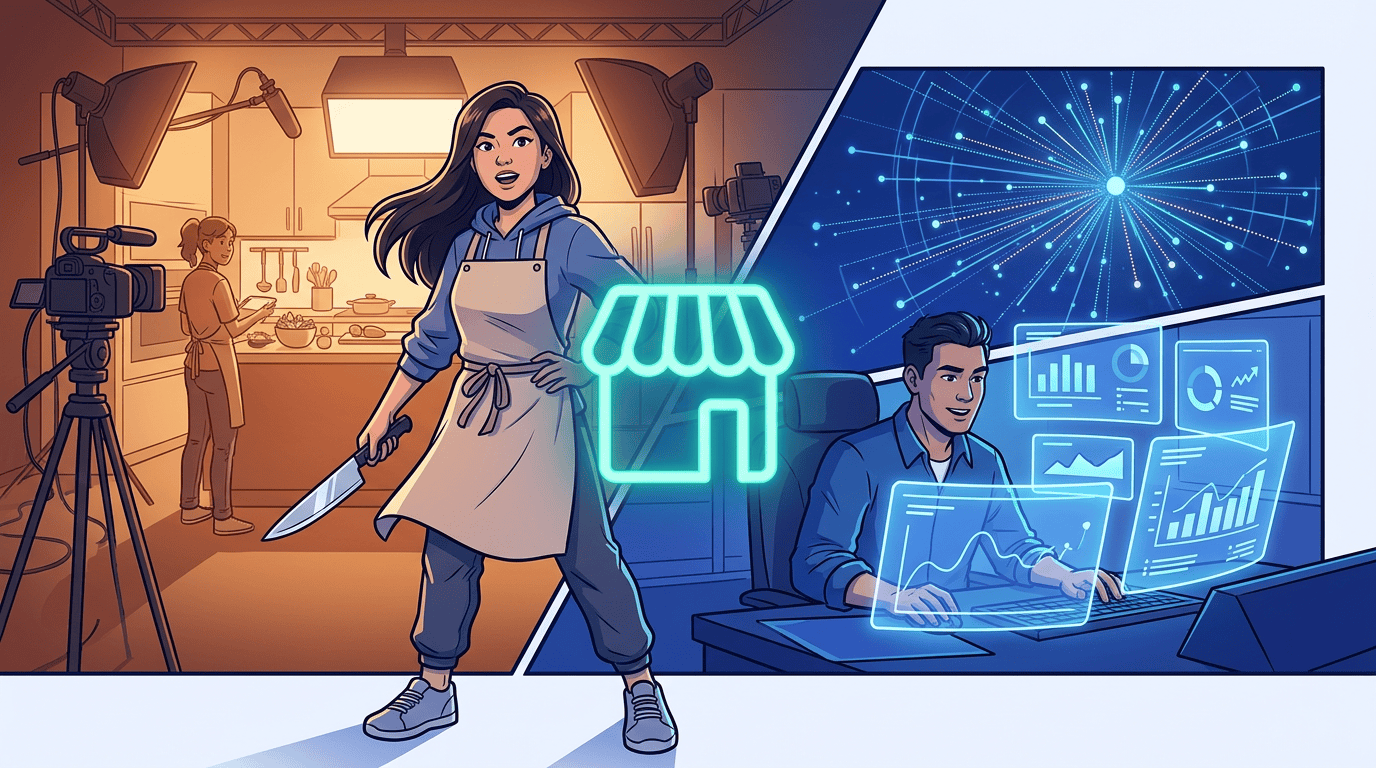
Ren runs the business behind an 8-million-subscriber creator. Six revenue streams, six workflows, zero unified view — until he builds one storefront that sells them all.

Daniel's grocery chain has product data, foot traffic, and first-party purchase signals. Now buyer agents want access — and they're willing to pay for it in real time.

Tomoko is Head of Media at Nova Motors. She's about to walk into a boardroom and pitch the C-suite on replacing their programmatic stack with agents. She has one hour.

Official reports, white papers, and analysis from AgenticAdvertising.org.
Today we're launching two Mastermind Councils — members-only communities of practice for leaders across brands, publishers, agencies, and tech platforms actively building the future of agentic marketing.
AAO is the trade organization defining the infrastructure for agentic advertising. Here's what membership actually gives you — and why joining now is different from joining later.

Ask ten people at Cannes what advertising looks like in a decade, and you'd expect ten different answers. We got something closer to one answer, told ten different ways.
An AI agent is about to spend $50,000 on advertising. No human reviewed the plan. This is the default state of agentic AI without governance built in. AAO was founded to answer that question clearly.
You've heard "protocol" a hundred times. Here's what it actually means, how we got from VAST to OpenRTB to AdCP, and why the missing layer was never operational — it was strategic.
Ten leaders. One question. Where do you trust an agent in your work today? Recorded on the Croisette at Cannes Lions 2026, the Agents of Change series captures what agentic advertising looks like in production — right now.
Access was the first milestone. Production readiness is the next. AdCP 3.1 is GA — here's what changes and why it matters for teams running real agentic advertising workflows.
AAO President Benjamin Masse joins the NDA Podcast at Cannes Lions 2026 to discuss embedded human judgment, why agentic is a business transformation not an IT project, and what it takes to build a standard without bias.
AI agent traffic grew nearly 8,000% year-over-year. At Cannes Lions, our panel asked the real question: if machines are making, moving, and buying much of what consumers see, how do we make sure it's still meant for humans?
AgenticAdvertising.org exists to make sure that as AI transforms advertising, humans stay in the decisions that matter. Here's the protocol, the organization, and the purpose behind it all.
If 2025 was the year the industry talked about AI, the 2026 Cannes Lions Festival of Creativity was the year agentic AI became the conversation. Here's where AAO showed up to make the case for embedded human judgment.
AAO is showing up in full force at Cannes Lions 2026 — here's everywhere you'll find us, from opening night cocktails to the Governance Breakfast Club.
AAO's inaugural Foundry summit brought together 150 of the industry's most senior practitioners alongside world-class authorities on creativity, commerce, content, and cognition — the moment an industry stopped debating whether agentic was coming and started deciding what it would become.
AgenticAdvertising.Org published Ad Context Protocol 3.0 — the clearest signal yet that agentic advertising has moved from experiment to infrastructure.
AgenticAdvertising.org is looking for a fractional Head of Membership & Growth (3 days/week) to turn early traction into a movement. If you're equal parts relationship builder and closer, this one's for you.
The Advertising Context Protocol (AdCP) is driving a fundamental architectural shift in marketing, moving the function's authority from transactional oversight to the orchestration of value-creating activities across the enterprise.
ads.txt made supply-chain transparency possible, but it was built for a flatter world. adagents.json can describe the actual commercial shape of modern media: direct paths, delegated paths, placements, collections, countries, time windows, and governed inventory groupings.
Programmatic advertising emerged to solve a specific challenge: determining which ad network would pay the most for a given impression. Yet premium publishers and brand advertisers face fundamentally different questions—ones more aligned with capacity-constrained markets like hotels or airlines. How should limited inventory or budget be allocated to maximize returns?
How horizontal middleware (AAIF) and vertical transaction protocols (AdCP, ACP) work together. A comprehensive guide to agentic AI standards and where to get involved.
Analysis and commentary from the people building agentic advertising.
Close to 200 leaders from brands, agencies, media owners and technology partners came together for the first AgenticAdvertising.org community meetup in Asia, hosted by Adzymic, PubMatic and Scope3.
Vendor-neutral guide to AdCP, the Advertising Context Protocol, including agentic media workflows, MCP/A2A transport, protocol domains, AdCP 3.1, signals, governance, and implementation paths.
Live agentic advertising orchestration prototype showing connected workflows across signals, identity, governance, creative, buying, measurement, and clean rooms.
A framework for packaging buyer intent, semantic meaning, provenance, privacy policy, activation rules, and measurement logic into executable advertising signal containers.
A 10-slide publisher pitch deck for the DACH market explaining AdCP + GAM integration, TMP privacy architecture, GDPR benefits, and getting started steps.
Programmatic overfocuses on digital metrics; agentic ads should optimize reach, sales, and brand across all media using MMM and market-level planning.
As AI agents proliferate across buyers, publishers, and data providers, the advertising industry faces a coordination problem — and solving it requires protocol infrastructure, not just smarter individual systems.
AdCP and ARTF look like competing frameworks for agentic advertising — but they operate at entirely different layers of the stack. AdCP handles campaign-level strategy, negotiation, and measurement. ARTF optimizes the auction itself. Understanding the distinction matters.
Data products are platform-agnostic, but their delivery is not. How Garritz built a multi-platform AdCP sales agent architecture that separates product definition from distribution — and why it matters for any data company selling through multiple programmatic pipes.
AGI, AI and cognitive science: In his DMEXCO column, Evgeny Popov explains why true relevance matters more in marketing than reach.
AdCP complements OpenRTB by adding long-horizon reasoning and context: giving sovereign publishers parity with walled gardens without commoditization.
PubMatic CEO discusses why the industry needs shared standards for agentic AI. "AI is moving faster than any shift...it's really important the industry aligns around shared standards early."
New nonprofit to unify marketing-media ecosystem around standards and practices. Industry veterans Randall Rothenberg and Matthew Egol brought in as interim leaders.
The past month saw three of the most monumental events in the history of marketing. By Randall Rothenberg and Matthew Egol.
How do I advertise on this property? How do I know that I'm actually buying what I think I'm buying?
What happened this week in agentic advertising.
Brave has begun rolling out version 1.93, which by default strips or randomizes three GPU-related fingerprinting signals exposed via WebGL and WebGPU — generic vendor/renderer strings, emptied WebGPU adapter descriptors, and randomized WebGL extension lists. The move contrasts sharply with Google's decision to permit advertiser use of device fingerprinting, highlighting a growing split between privacy-focused browsers and the dominant ad platform.
Amazon has reinstated binding individual arbitration and a class action waiver in its consumer Conditions of Use, effective August 14, 2026, five years after abandoning arbitration under a wave of 75,000 coordinated Echo privacy demands. The new terms include a mandatory 60-day pre-arbitration process and detailed 'Mass Arbitration' batching rules designed to neutralize the exact mass-filing tactic that forced Amazon's 2021 retreat, and the same document governs Amazon's Agent Terms restricting how AI shopping agents (like Perplexity's Comet) can interact with its store.
This article outlines a 4-step roadmap for adopting AI agents in Google Ads management: build a strong knowledge base and clean data foundation, exhaust off-the-shelf AI tools before custom builds, develop custom systems only when complexity demands it, and cultivate early adopters within the organization. The author argues that most businesses fail not due to technology limitations but because they skip foundational work or try to automate everything instead of focusing on where AI genuinely creates leverage.
Nielsen's $2.15B acquisition of DoubleVerify and Publicis's earlier $2.2B purchase of LiveRamp are framed as AI moves but are really about locking down the input layers—identity, verification, and currency—that automated media-buying agents will depend on. The author argues that as AI commoditizes creative, planning, and optimization, the real value shifts to controlling what gets measured and trusted, since these permissioned data assets can't be replicated by prompting a model.
Dolby is bringing its OptiView streaming tech to sports, starting with the Seattle Seahawks' preseason opener, enabling personalized, low-latency streams with per-user ad targeting and customization. The tech also underlies broader ambitions across NFL, NASCAR and other partners, focused on AI-driven viewer engagement, dynamic ad insertion, and adjustable audio/visual experiences.
Luma and Dumbstruck announced a partnership called Creative Intelligence, combining Dumbstruck's emotion analytics with Luma's AI-powered video editing to help advertisers identify which creative will perform best before spending media dollars. The closed-loop system also enables scalable personalization and localization of ad creative, with Wayfair cited as an early adopter.
InMobi Advertising has launched a conversational AI agent within its Buyer Hub platform, enabling media buyers to discover inventory and build deals through natural language. The platform is now open to agencies and managed service DSPs with role-based access controls, self-serve reporting, and deals forecasting. This follows InMobi's partnership with Scope3, positioning the company with agentic tools on both the supply and demand sides of the transaction.
Xnurta launched Xnurta MCP, a Model Context Protocol server connecting its retail media data and intelligence to AI assistants like ChatGPT and Claude. The initial release offers read-only data querying, with a phased roadmap through October 2025 to add governed write capabilities, letting AI assistants manage campaign groups, bulk operations, and eventually create campaigns within advertiser-defined 'action spaces'.