Find the story that's about your world — then go deeper with analysis, industry news, and community perspectives.
No content matches these filters.
Try a different topic, or explore all content.
View all Meet the communityFictional scenarios, real protocol. See how agentic advertising plays out through the people building it.
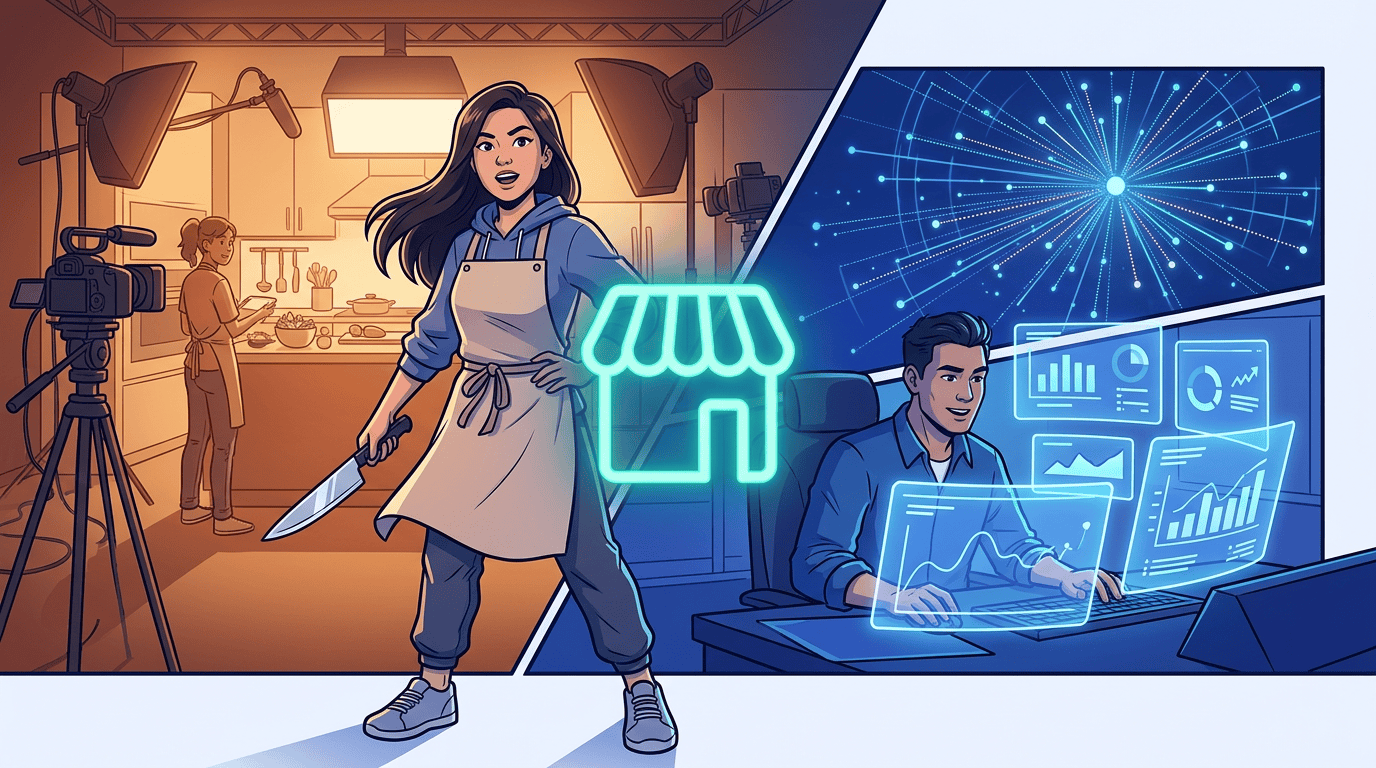
Ren runs the business behind an 8-million-subscriber creator. Six revenue streams, six workflows, zero unified view — until he builds one storefront that sells them all.

Daniel's grocery chain has product data, foot traffic, and first-party purchase signals. Now buyer agents want access — and they're willing to pay for it in real time.

Tomoko is Head of Media at Nova Motors. She's about to walk into a boardroom and pitch the C-suite on replacing their programmatic stack with agents. She has one hour.

Official reports, white papers, and analysis from AgenticAdvertising.org.
AdCP 3.2 is live, the Brand Council and Marketing Collab are launching, and the founding Board is in place. Highlights from the October 1 Town Hall.
AAO is launching the Brand Council, a small group of leaders who steward marketing's future, guide the protocol agents will run on, and set the agenda instead of reacting to it.
Does agentic marketing grow revenue, cut cost, or both? The Marketing Collab is a real-budget environment where brands, publishers, agencies, and tech and data platforms run experiments together on AdCP.
AgenticAdvertising.org announces Benjamin Masse as Board President alongside a founding Board of Directors representing leaders across brands, agencies, publishers, and technology providers.
Ten leaders from across the ecosystem — buy-side, sell-side, verification, infrastructure, and creative — share where they already trust autonomous agents, where humans must stay in the loop, and what advertising looks like in 2036.
AAO President Benjamin Masse talks with ADZINE about the infrastructure imbalance holding back the open web, why agentic advertising is more than a buzzword, and how AdCP's governance model protects long-term equity across the ecosystem.
Nine leaders, nine seats in the ecosystem, one requirement: where human judgment stays non-negotiable no matter how far agentic advertising scales.
Today we're launching two Mastermind Councils — members-only communities of practice for leaders across brands, publishers, agencies, and tech platforms actively building the future of agentic marketing.
AAO is the trade organization defining the infrastructure for agentic advertising. Here's what membership actually gives you — and why joining now is different from joining later.

Ask ten people at Cannes what advertising looks like in a decade, and you'd expect ten different answers. We got something closer to one answer, told ten different ways.

An AI agent is about to spend $50,000 on advertising. No human reviewed the plan. This is the default state of agentic AI without governance built in. AAO was founded to answer that question clearly.
You've heard "protocol" a hundred times. Here's what it actually means, how we got from VAST to OpenRTB to AdCP, and why the missing layer was never operational — it was strategic.
Ten leaders. One question. Where do you trust an agent in your work today? Recorded on the Croisette at Cannes Lions 2026, the Agents of Change series captures what agentic advertising looks like in production — right now.
Access was the first milestone. Production readiness is the next. AdCP 3.1 is GA — here's what changes and why it matters for teams running real agentic advertising workflows.
AAO President Benjamin Masse joins the NDA Podcast at Cannes Lions 2026 to discuss embedded human judgment, why agentic is a business transformation not an IT project, and what it takes to build a standard without bias.
AI agent traffic grew nearly 8,000% year-over-year. At Cannes Lions, our panel asked the real question: if machines are making, moving, and buying much of what consumers see, how do we make sure it's still meant for humans?
AgenticAdvertising.org exists to make sure that as AI transforms advertising, humans stay in the decisions that matter. Here's the protocol, the organization, and the purpose behind it all.
If 2025 was the year the industry talked about AI, the 2026 Cannes Lions Festival of Creativity was the year agentic AI became the conversation. Here's where AAO showed up to make the case for embedded human judgment.
AAO is showing up in full force at Cannes Lions 2026 — here's everywhere you'll find us, from opening night cocktails to the Governance Breakfast Club.
AAO's inaugural Foundry summit brought together 150 of the industry's most senior practitioners alongside world-class authorities on creativity, commerce, content, and cognition — the moment an industry stopped debating whether agentic was coming and started deciding what it would become.
AgenticAdvertising.Org published Ad Context Protocol 3.0 — the clearest signal yet that agentic advertising has moved from experiment to infrastructure.
AgenticAdvertising.org is looking for a fractional Head of Membership & Growth (3 days/week) to turn early traction into a movement. If you're equal parts relationship builder and closer, this one's for you.
The Advertising Context Protocol (AdCP) is driving a fundamental architectural shift in marketing, moving the function's authority from transactional oversight to the orchestration of value-creating activities across the enterprise.
ads.txt made supply-chain transparency possible, but it was built for a flatter world. adagents.json can describe the actual commercial shape of modern media: direct paths, delegated paths, placements, collections, countries, time windows, and governed inventory groupings.
Programmatic advertising emerged to solve a specific challenge: determining which ad network would pay the most for a given impression. Yet premium publishers and brand advertisers face fundamentally different questions—ones more aligned with capacity-constrained markets like hotels or airlines. How should limited inventory or budget be allocated to maximize returns?
How horizontal middleware (AAIF) and vertical transaction protocols (AdCP, ACP) work together. A comprehensive guide to agentic AI standards and where to get involved.
Analysis and commentary from the people building agentic advertising.
True Relevance shares how their AdCP contextual signals agent works in production, covering the four-call flow from natural language brief to DSP/SSP activation.
AgenticAdvertising.org launched its Australian chapter with Agentic Advertising Connect: 200+ people from 100+ companies, and publishers and buyers working through who owns the media decision when agents are in the loop.
An open letter to the incoming ANA CEO urging them to embrace open AI standards (AdCP) and help marketers reclaim control from ad-tech intermediaries.
Social, reliable reporting and your own data come to agentic buying with AdCP 3.2.
Agentic buying is happening now, and it is simple to execute. Lyft booked a Citi Bike audio campaign with iHeartMedia using AdCP, here is how they did it.
Close to 200 leaders from brands, agencies, media owners and technology partners came together for the first AgenticAdvertising.org community meetup in Asia, hosted by Adzymic, PubMatic and Scope3.
Vendor-neutral guide to AdCP, the Advertising Context Protocol, including agentic media workflows, MCP/A2A transport, protocol domains, AdCP 3.1, signals, governance, and implementation paths.
Live agentic advertising orchestration prototype showing connected workflows across signals, identity, governance, creative, buying, measurement, and clean rooms.
A framework for packaging buyer intent, semantic meaning, provenance, privacy policy, activation rules, and measurement logic into executable advertising signal containers.
A 10-slide publisher pitch deck for the DACH market explaining AdCP + GAM integration, TMP privacy architecture, GDPR benefits, and getting started steps.
Programmatic overfocuses on digital metrics; agentic ads should optimize reach, sales, and brand across all media using MMM and market-level planning.
As AI agents proliferate across buyers, publishers, and data providers, the advertising industry faces a coordination problem — and solving it requires protocol infrastructure, not just smarter individual systems.
AdCP and ARTF look like competing frameworks for agentic advertising — but they operate at entirely different layers of the stack. AdCP handles campaign-level strategy, negotiation, and measurement. ARTF optimizes the auction itself. Understanding the distinction matters.
Data products are platform-agnostic, but their delivery is not. How Garritz built a multi-platform AdCP sales agent architecture that separates product definition from distribution — and why it matters for any data company selling through multiple programmatic pipes.
AGI, AI and cognitive science: In his DMEXCO column, Evgeny Popov explains why true relevance matters more in marketing than reach.
AdCP complements OpenRTB by adding long-horizon reasoning and context: giving sovereign publishers parity with walled gardens without commoditization.
PubMatic CEO discusses why the industry needs shared standards for agentic AI. "AI is moving faster than any shift...it's really important the industry aligns around shared standards early."
New nonprofit to unify marketing-media ecosystem around standards and practices. Industry veterans Randall Rothenberg and Matthew Egol brought in as interim leaders.
The past month saw three of the most monumental events in the history of marketing. By Randall Rothenberg and Matthew Egol.
How do I advertise on this property? How do I know that I'm actually buying what I think I'm buying?
What happened this week in agentic advertising.
Omneky launched the Always-On AI Growth Agent, an autonomous agent that takes a campaign from brief to live ads and then keeps monitoring performance, refreshing creative, and proposing campaign updates around the clock. It keeps persistent per-brand state, bridges Slack and web workflows, and leaves budgets, assets, and approvals under marketer control. Omneky claims an 8.8/10 ad quality score on its own TASTE BENCH evaluation and $350M+ in annualized ad spend, with integrations across Meta, Google, LinkedIn, TikTok, Pinterest, X, YouTube, and OpenAI Ads.
OpenAI told Adweek it won't give ChatGPT advertisers prompt-level or inferred-intent reports. Ads are matched to queries written by an internal AI 'orchestrator' agent, and advertisers see only aggregate metrics (impressions, clicks, spend, CTR, CPC, CPM, conversions) plus loosely guiding 'context hints' rather than keyword targeting. This contrasts with Google, which at least surfaces an approximation of user intent for AI search terms.
OpenAI reports 100,000+ advertisers and a $1B annualized ad run rate on ChatGPT less than 200 days after launch, but early advertiser results are mixed: Adthena found 52% of 30 enterprise brands struggled to recover spend, while 26% matched or beat Google Ads. Agency and advertiser anecdotes point to tracking gaps, limited targeting and delivery transparency, low-quality leads, and budgets kept small as teams wait for the product to mature.
Fortune reports that Amazon has held talks about letting Meta's Muse AI shopping agent access its marketplace, which would end its current block. Amazon's concerns center on lost advertising revenue (since its ad business depends on humans seeing ads), the quality of Muse's product recommendations, and the effect on its customer relationships. Retailers like Walmart, Best Buy, Gap, and Sephora have opened to AI agents, while Amazon has blocked Perplexity's agent and promotes its own Alexa for Shopping.
Reddit COO Jen Wong outlines a 2027 ad agenda built on search ads, AI-driven shopping (Reddit Reviews), and agentic buying, including plans to test an MCP server and agent-to-agent ad buying inside its Reddit Max automated platform. Q3 ad revenue grew 54% YoY to $847M, but US daily active users fell 2% and search traffic remains a risk, making a performance-focused, logged-in ad business more urgent.
Shirley Marschall uses a haunted-shutter metaphor to examine how AI agents and bots are reshaping digital advertising: automated traffic is now 53% of the web, agent traffic is surging, and the industry treats the same bot as an intruder near an ad but a VIP when it reads a product page. The piece argues that agent-to-agent buying is arriving faster than measurement and attribution standards, citing the IAB's AI-Era Attribution Blueprint and platform data gaps.
Sellforte announced general availability of Sellforte MCP, which connects its incrementality measurement to AI assistants and agents like Claude, supplying incremental and marginal ROAS per campaign and ad set. Finnish Design Shop and agency Intentio report answering 1,000+ incrementality questions in 11 weeks and creating about 25x more budget scenarios. The product is free for existing Sellforte customers.
CNBC reports that Meta's ad-free Muse personal AI agent is already lifting Instagram's ad business by prompting users to organize saved posts (many of which are shoppable items or ads), which a senior executive says raises advertiser conversions. Zuckerberg said 25% of Muse users shop via the agent at an average purchase over $200, Meta plans to take a small transaction fee, and Forter data shows Muse captured 51% of agentic orders in the week ending Nov. 22.