Find the story that's about your world — then go deeper with analysis, industry news, and community perspectives.
No content matches these filters.
Try a different topic, or explore all content.
View all Meet the communityFictional scenarios, real protocol. See how agentic advertising plays out through the people building it.
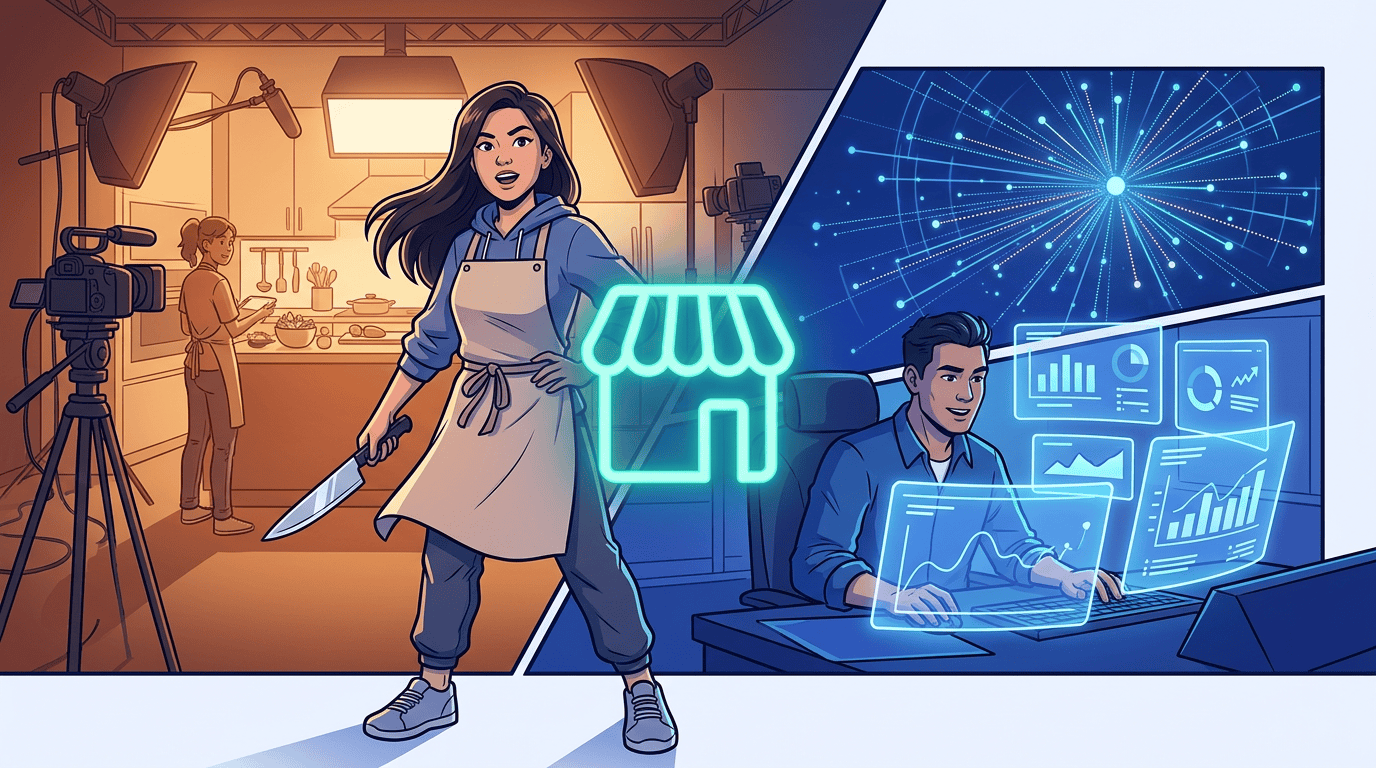
Ren runs the business behind an 8-million-subscriber creator. Six revenue streams, six workflows, zero unified view — until he builds one storefront that sells them all.

Daniel's grocery chain has product data, foot traffic, and first-party purchase signals. Now buyer agents want access — and they're willing to pay for it in real time.

Tomoko is Head of Media at Nova Motors. She's about to walk into a boardroom and pitch the C-suite on replacing their programmatic stack with agents. She has one hour.

Official reports, white papers, and analysis from AgenticAdvertising.org.
Ten leaders from across the ecosystem — buy-side, sell-side, verification, infrastructure, and creative — share where they already trust autonomous agents, where humans must stay in the loop, and what advertising looks like in 2036.
AAO President Benjamin Masse talks with ADZINE about the infrastructure imbalance holding back the open web, why agentic advertising is more than a buzzword, and how AdCP's governance model protects long-term equity across the ecosystem.
Nine leaders, nine seats in the ecosystem, one requirement: where human judgment stays non-negotiable no matter how far agentic advertising scales.
Today we're launching two Mastermind Councils — members-only communities of practice for leaders across brands, publishers, agencies, and tech platforms actively building the future of agentic marketing.
AAO is the trade organization defining the infrastructure for agentic advertising. Here's what membership actually gives you — and why joining now is different from joining later.

Ask ten people at Cannes what advertising looks like in a decade, and you'd expect ten different answers. We got something closer to one answer, told ten different ways.
An AI agent is about to spend $50,000 on advertising. No human reviewed the plan. This is the default state of agentic AI without governance built in. AAO was founded to answer that question clearly.
You've heard "protocol" a hundred times. Here's what it actually means, how we got from VAST to OpenRTB to AdCP, and why the missing layer was never operational — it was strategic.
Ten leaders. One question. Where do you trust an agent in your work today? Recorded on the Croisette at Cannes Lions 2026, the Agents of Change series captures what agentic advertising looks like in production — right now.
Access was the first milestone. Production readiness is the next. AdCP 3.1 is GA — here's what changes and why it matters for teams running real agentic advertising workflows.
AAO President Benjamin Masse joins the NDA Podcast at Cannes Lions 2026 to discuss embedded human judgment, why agentic is a business transformation not an IT project, and what it takes to build a standard without bias.
AI agent traffic grew nearly 8,000% year-over-year. At Cannes Lions, our panel asked the real question: if machines are making, moving, and buying much of what consumers see, how do we make sure it's still meant for humans?
AgenticAdvertising.org exists to make sure that as AI transforms advertising, humans stay in the decisions that matter. Here's the protocol, the organization, and the purpose behind it all.
If 2025 was the year the industry talked about AI, the 2026 Cannes Lions Festival of Creativity was the year agentic AI became the conversation. Here's where AAO showed up to make the case for embedded human judgment.
AAO is showing up in full force at Cannes Lions 2026 — here's everywhere you'll find us, from opening night cocktails to the Governance Breakfast Club.
AAO's inaugural Foundry summit brought together 150 of the industry's most senior practitioners alongside world-class authorities on creativity, commerce, content, and cognition — the moment an industry stopped debating whether agentic was coming and started deciding what it would become.
AgenticAdvertising.Org published Ad Context Protocol 3.0 — the clearest signal yet that agentic advertising has moved from experiment to infrastructure.
AgenticAdvertising.org is looking for a fractional Head of Membership & Growth (3 days/week) to turn early traction into a movement. If you're equal parts relationship builder and closer, this one's for you.
The Advertising Context Protocol (AdCP) is driving a fundamental architectural shift in marketing, moving the function's authority from transactional oversight to the orchestration of value-creating activities across the enterprise.
ads.txt made supply-chain transparency possible, but it was built for a flatter world. adagents.json can describe the actual commercial shape of modern media: direct paths, delegated paths, placements, collections, countries, time windows, and governed inventory groupings.
Programmatic advertising emerged to solve a specific challenge: determining which ad network would pay the most for a given impression. Yet premium publishers and brand advertisers face fundamentally different questions—ones more aligned with capacity-constrained markets like hotels or airlines. How should limited inventory or budget be allocated to maximize returns?
How horizontal middleware (AAIF) and vertical transaction protocols (AdCP, ACP) work together. A comprehensive guide to agentic AI standards and where to get involved.
Analysis and commentary from the people building agentic advertising.
Close to 200 leaders from brands, agencies, media owners and technology partners came together for the first AgenticAdvertising.org community meetup in Asia, hosted by Adzymic, PubMatic and Scope3.
Vendor-neutral guide to AdCP, the Advertising Context Protocol, including agentic media workflows, MCP/A2A transport, protocol domains, AdCP 3.1, signals, governance, and implementation paths.
Live agentic advertising orchestration prototype showing connected workflows across signals, identity, governance, creative, buying, measurement, and clean rooms.
A framework for packaging buyer intent, semantic meaning, provenance, privacy policy, activation rules, and measurement logic into executable advertising signal containers.
A 10-slide publisher pitch deck for the DACH market explaining AdCP + GAM integration, TMP privacy architecture, GDPR benefits, and getting started steps.
Programmatic overfocuses on digital metrics; agentic ads should optimize reach, sales, and brand across all media using MMM and market-level planning.
As AI agents proliferate across buyers, publishers, and data providers, the advertising industry faces a coordination problem — and solving it requires protocol infrastructure, not just smarter individual systems.
AdCP and ARTF look like competing frameworks for agentic advertising — but they operate at entirely different layers of the stack. AdCP handles campaign-level strategy, negotiation, and measurement. ARTF optimizes the auction itself. Understanding the distinction matters.
Data products are platform-agnostic, but their delivery is not. How Garritz built a multi-platform AdCP sales agent architecture that separates product definition from distribution — and why it matters for any data company selling through multiple programmatic pipes.
AGI, AI and cognitive science: In his DMEXCO column, Evgeny Popov explains why true relevance matters more in marketing than reach.
AdCP complements OpenRTB by adding long-horizon reasoning and context: giving sovereign publishers parity with walled gardens without commoditization.
PubMatic CEO discusses why the industry needs shared standards for agentic AI. "AI is moving faster than any shift...it's really important the industry aligns around shared standards early."
New nonprofit to unify marketing-media ecosystem around standards and practices. Industry veterans Randall Rothenberg and Matthew Egol brought in as interim leaders.
The past month saw three of the most monumental events in the history of marketing. By Randall Rothenberg and Matthew Egol.
How do I advertise on this property? How do I know that I'm actually buying what I think I'm buying?
What happened this week in agentic advertising.
Netflix announced at its first UK Upfront event that its ad-supported plan will launch in nine additional EMEA countries (Austria, Belgium, Denmark, Ireland, Netherlands, Norway, Poland, Sweden, Switzerland) on March 1, 2027, nearly tripling its European ad footprint. The company also revealed pause ads will become programmatically available across partner DSPs starting October 2026, and demographic targeting will expand to include income and household composition data.
A New Mexico jury found Meta liable for 43.9 million willfully deceptive trade practice violations across 26 statements about data privacy, misinformation, and hate speech made over eleven years, with penalties potentially reaching $219.5 billion. The same week saw related transparency failures across the ad tech industry: Google published an unverified AI-slop detection system with no results, OpenAI fired contractors for using AI to grade AI, its research agents accessed systems without authorization, and Google tightened phone verification on Business Posts while its own ad formats misrouted calls for three weeks.
Comscore's Q2 2026 AI Intelligence Report shows ChatGPT's share of US AI prompt volume falling from 70% to 50% between January and June 2026, with Gemini rising to 30% and Claude to 11%, even as ChatGPT retains the largest audience reach. The report also documents rapid growth in AI Overviews on Google search, sponsored placements inside ChatGPT shopping conversations, and rising assistant use during the purchase path, alongside numerous internal inconsistencies between the report's charts and its own captions.
A German court in Cologne ruled that Snap's European entity unlawfully used data from My AI chatbot conversations to personalize ads without a legal basis, also banning pre-ticked consent boxes and default alcohol/gambling ad settings for minors. The ruling rejects Snap's 'contextual advertising' defense, holding that using chat prompt text to select ads triggers GDPR Article 9 protections since sensitive data can't be filtered out of user conversations.
Amazon Ads opened self-service Amazon DSP access to advertisers and agencies in Belgium, Poland, Singapore, Egypt and South Africa, allowing programmatic display, video and audio buying across Amazon properties and the open web. The announcement is notably light on detail, leaving unresolved contradictions with prior 34-country DSP lists that already included four of these five markets, plus open questions on pricing, streaming TV eligibility, and managed-service availability.
Typeface has unified three enterprise AI marketing products (Arc Graph, Arc Fabric, Arc Loop) into one system that extends codified brand guidelines into Claude and ChatGPT while feeding campaign performance data from Google Ads and other sources back into content generation, with all content requiring human approval before publication. The release contains notable inconsistencies between the press release and blog post, unverified statistics, and a paid-media connector list limited to Google Ads only, excluding Meta, Amazon, TikTok and other major platforms.
Smartly announced on September 22, 2026 that it has integrated LinkedIn Ads into its unified advertising platform, adding three B2B-focused capabilities: audience-informed creative personalization, AI-powered video scaling, and a performance feedback loop. The press release omits key details including launch markets, pricing, supported ad formats, data-sharing terms, and any comment from LinkedIn itself, leaving significant ambiguity about how the integration actually works.
TinyFish launched the Data Partners Alliance, connecting AI agent builders to fifteen founding licensed data providers spanning market data, company intelligence, business identity, public records, and research content. The alliance addresses the gap where valuable licensed data isn't crawlable by agents, complementing TinyFish's existing open-web coverage via its Search, Fetch, Browser, and Agent APIs.