Find the story that's about your world — then go deeper with analysis, industry news, and community perspectives.
No content matches these filters.
Try a different topic, or explore all content.
View all Meet the communityFictional scenarios, real protocol. See how agentic advertising plays out through the people building it.
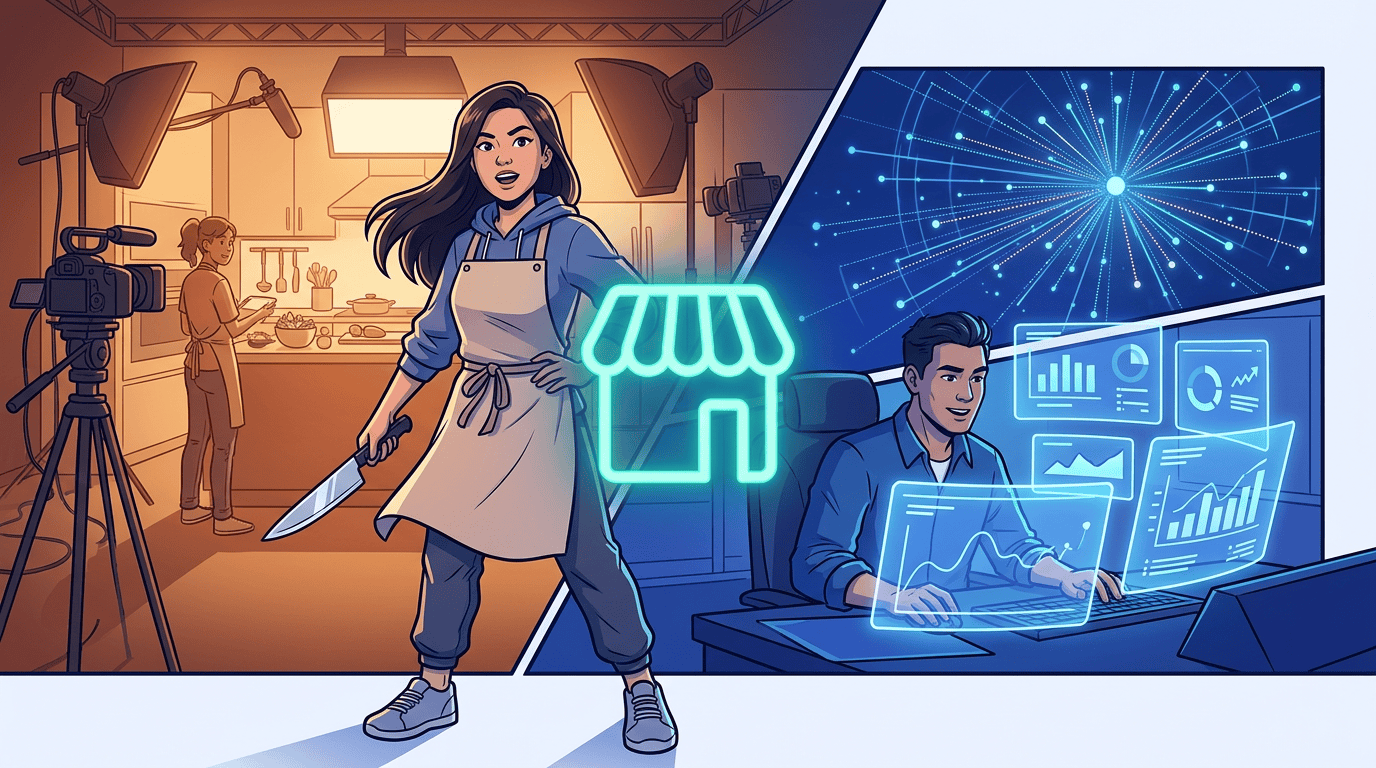
Ren runs the business behind an 8-million-subscriber creator. Six revenue streams, six workflows, zero unified view — until he builds one storefront that sells them all.

Daniel's grocery chain has product data, foot traffic, and first-party purchase signals. Now buyer agents want access — and they're willing to pay for it in real time.

Tomoko is Head of Media at Nova Motors. She's about to walk into a boardroom and pitch the C-suite on replacing their programmatic stack with agents. She has one hour.

Official reports, white papers, and analysis from AgenticAdvertising.org.
AgenticAdvertising.org announces Benjamin Masse as Board President alongside a founding Board of Directors representing leaders across brands, agencies, publishers, and technology providers.
Ten leaders from across the ecosystem — buy-side, sell-side, verification, infrastructure, and creative — share where they already trust autonomous agents, where humans must stay in the loop, and what advertising looks like in 2036.
AAO President Benjamin Masse talks with ADZINE about the infrastructure imbalance holding back the open web, why agentic advertising is more than a buzzword, and how AdCP's governance model protects long-term equity across the ecosystem.
Nine leaders, nine seats in the ecosystem, one requirement: where human judgment stays non-negotiable no matter how far agentic advertising scales.
Today we're launching two Mastermind Councils — members-only communities of practice for leaders across brands, publishers, agencies, and tech platforms actively building the future of agentic marketing.
AAO is the trade organization defining the infrastructure for agentic advertising. Here's what membership actually gives you — and why joining now is different from joining later.

Ask ten people at Cannes what advertising looks like in a decade, and you'd expect ten different answers. We got something closer to one answer, told ten different ways.

An AI agent is about to spend $50,000 on advertising. No human reviewed the plan. This is the default state of agentic AI without governance built in. AAO was founded to answer that question clearly.
You've heard "protocol" a hundred times. Here's what it actually means, how we got from VAST to OpenRTB to AdCP, and why the missing layer was never operational — it was strategic.
Ten leaders. One question. Where do you trust an agent in your work today? Recorded on the Croisette at Cannes Lions 2026, the Agents of Change series captures what agentic advertising looks like in production — right now.
Access was the first milestone. Production readiness is the next. AdCP 3.1 is GA — here's what changes and why it matters for teams running real agentic advertising workflows.
AAO President Benjamin Masse joins the NDA Podcast at Cannes Lions 2026 to discuss embedded human judgment, why agentic is a business transformation not an IT project, and what it takes to build a standard without bias.
AI agent traffic grew nearly 8,000% year-over-year. At Cannes Lions, our panel asked the real question: if machines are making, moving, and buying much of what consumers see, how do we make sure it's still meant for humans?
AgenticAdvertising.org exists to make sure that as AI transforms advertising, humans stay in the decisions that matter. Here's the protocol, the organization, and the purpose behind it all.
If 2025 was the year the industry talked about AI, the 2026 Cannes Lions Festival of Creativity was the year agentic AI became the conversation. Here's where AAO showed up to make the case for embedded human judgment.
AAO is showing up in full force at Cannes Lions 2026 — here's everywhere you'll find us, from opening night cocktails to the Governance Breakfast Club.
AAO's inaugural Foundry summit brought together 150 of the industry's most senior practitioners alongside world-class authorities on creativity, commerce, content, and cognition — the moment an industry stopped debating whether agentic was coming and started deciding what it would become.
AgenticAdvertising.Org published Ad Context Protocol 3.0 — the clearest signal yet that agentic advertising has moved from experiment to infrastructure.
AgenticAdvertising.org is looking for a fractional Head of Membership & Growth (3 days/week) to turn early traction into a movement. If you're equal parts relationship builder and closer, this one's for you.
The Advertising Context Protocol (AdCP) is driving a fundamental architectural shift in marketing, moving the function's authority from transactional oversight to the orchestration of value-creating activities across the enterprise.
ads.txt made supply-chain transparency possible, but it was built for a flatter world. adagents.json can describe the actual commercial shape of modern media: direct paths, delegated paths, placements, collections, countries, time windows, and governed inventory groupings.
Programmatic advertising emerged to solve a specific challenge: determining which ad network would pay the most for a given impression. Yet premium publishers and brand advertisers face fundamentally different questions—ones more aligned with capacity-constrained markets like hotels or airlines. How should limited inventory or budget be allocated to maximize returns?
How horizontal middleware (AAIF) and vertical transaction protocols (AdCP, ACP) work together. A comprehensive guide to agentic AI standards and where to get involved.
Analysis and commentary from the people building agentic advertising.
Social, reliable reporting and your own data come to agentic buying with AdCP 3.2.
Agentic buying is happening now, and it is simple to execute. Lyft booked a Citi Bike audio campaign with iHeartMedia using AdCP, here is how they did it.
Close to 200 leaders from brands, agencies, media owners and technology partners came together for the first AgenticAdvertising.org community meetup in Asia, hosted by Adzymic, PubMatic and Scope3.
Vendor-neutral guide to AdCP, the Advertising Context Protocol, including agentic media workflows, MCP/A2A transport, protocol domains, AdCP 3.1, signals, governance, and implementation paths.
Live agentic advertising orchestration prototype showing connected workflows across signals, identity, governance, creative, buying, measurement, and clean rooms.
A framework for packaging buyer intent, semantic meaning, provenance, privacy policy, activation rules, and measurement logic into executable advertising signal containers.
A 10-slide publisher pitch deck for the DACH market explaining AdCP + GAM integration, TMP privacy architecture, GDPR benefits, and getting started steps.
Programmatic overfocuses on digital metrics; agentic ads should optimize reach, sales, and brand across all media using MMM and market-level planning.
As AI agents proliferate across buyers, publishers, and data providers, the advertising industry faces a coordination problem — and solving it requires protocol infrastructure, not just smarter individual systems.
AdCP and ARTF look like competing frameworks for agentic advertising — but they operate at entirely different layers of the stack. AdCP handles campaign-level strategy, negotiation, and measurement. ARTF optimizes the auction itself. Understanding the distinction matters.
Data products are platform-agnostic, but their delivery is not. How Garritz built a multi-platform AdCP sales agent architecture that separates product definition from distribution — and why it matters for any data company selling through multiple programmatic pipes.
AGI, AI and cognitive science: In his DMEXCO column, Evgeny Popov explains why true relevance matters more in marketing than reach.
AdCP complements OpenRTB by adding long-horizon reasoning and context: giving sovereign publishers parity with walled gardens without commoditization.
PubMatic CEO discusses why the industry needs shared standards for agentic AI. "AI is moving faster than any shift...it's really important the industry aligns around shared standards early."
New nonprofit to unify marketing-media ecosystem around standards and practices. Industry veterans Randall Rothenberg and Matthew Egol brought in as interim leaders.
The past month saw three of the most monumental events in the history of marketing. By Randall Rothenberg and Matthew Egol.
How do I advertise on this property? How do I know that I'm actually buying what I think I'm buying?
What happened this week in agentic advertising.
Amazon Ads VP Kelly MacLean discusses the AI-powered ad platform announced at unBoxed, which merges the ad console and DSP so advertisers can launch a programmatic campaign in as few as four clicks. In beta tests, advertisers using Amazon Ads Agent reported 18% lower CPMs, 16% lower CPAs and a 65% improvement in delivery. MacLean credits Amazon's authenticated graph (90% of US households) and argues marketers will own the 'why and what' while AI handles the 'how'.
ADOTAT argues that Amazon retired the 'Amazon DSP' name at unBoxed 2026 but kept the engine, repackaging it as DVA+ with manual controls (audience targeting, deals, frequency, bidding) behind an advanced-settings toggle. The most automated product, Full-Funnel Campaigns ($100/day minimum), is live in the US while the more controllable DVA+ tier remained in closed beta. Amazon says all programmatic capabilities remain available, so the dispute centers on defaults and on Amazon's AI agent both optimizing and grading campaigns with its own data.
A PPC Land daily roundup led by Meta's revised Commercial Terms (effective Oct 30, 2026), which let it crawl advertisers' linked websites with automated tools to train its AI products, with acceptance by continued use and no partial opt-out. It also covers Google paying Reach and CNN for AI content rights, a 65-researcher paper arguing consent can't govern AI agents, Usercentrics data on 'resigned consent', and agentic tooling updates (ChatGPT Chrome tab control, Google Universal Cart, VideoAmp planning agents).
Brandon Lazovic's documentation-based analysis of Google's Universal Cart (launched Oct 15, 2026) finds that retailers receive no signal when a shopper saves a product; Google holds saved items and sends one cart request to the merchant only at transfer. This release supports only cart creation and transfer (no updates or sync), Merchant Center reporting starts at 'Clicks to Buy' with no save counts, and a single VPN test found UCP profiles for only two of eight named launch merchants.
A Raptive survey of 3,083 U.S. consumers finds 74% say it's extremely or very important to know where an AI answer comes from, and trust in AI answers jumps from 42% with no source to roughly 77-79% when a trusted publisher or creator is cited. Only 19% would believe an AI over a trusted source they already know, and more than half often accept AI answers without verifying.
LG Ad Solutions and Magnite extended their partnership for three years, keeping SpringServe as LG's exclusive CTV video ad server and Magnite as a preferred programmatic partner across North America, APAC, and EMEA. LG is also opening its Home Screen inventory to agentic buying through Magnite's Seller Agent, with independent agency H/L as the first buyer, activating a campaign for the Northern California Toyota Dealers Association.
Doc Searls-style privacy blogger Don Marti describes how California's CIPA (1967) private right of action is pushing companies through stages of adaptation, from consent banners to honoring Global Privacy Control with separate code paths. He argues that trackability-obsessed measurement underweights privacy-conscious high-value customers, that Meta's and Google's terms increasingly harm both users and legitimate advertisers (scam ads, AI scraping clauses), and that advertisers should reduce dependence on Big Tech.
A PPC Land special edition compares Meta's 2021 metaverse-driven rename (which cost $70-80B in Reality Labs losses before retreat) with Amazon's September 2026 unBoxed relaunch, where Amazon DSP became DVA and the console and DSP were merged into the conversational Amazon Ads Agent. The piece argues Amazon is naming a mechanism that already runs (automation defaults like DVA+, Full-Funnel Campaigns, Brand+/Performance+) rather than a destination, which makes success likelier, while flagging open questions on control, measurement, fees and unaudited performance claims.